Social Annotation in Educational Practices

Overview
Social annotation refers to the application of web annotation technologies in educational settings to support student interaction around course materials and with each other. It is a genre of information technology that allows a user to annotate information in a shared document and anchor a discussion to the annotated information. When it is used socially in online classrooms, it can support social reading, group sensemaking, knowledge construction, community building, and collaborative learning.
Since 2020, we have been collaborating with instructors from various institutions to support the design and facilitation of social annotation activities, aiming to engage college students in reading and discussing course materials. Following a co-design approach, we design both pedagogical and technological innovations, leveraging web annotation tools such as Hypothes.is and Perusall.
Publications and Updates
- [Conference] We organized a symposium at ISLS24: Bridging Social Annotation Practice with Perspectives from the Learning Sciences and CSCL. Check out our website here.

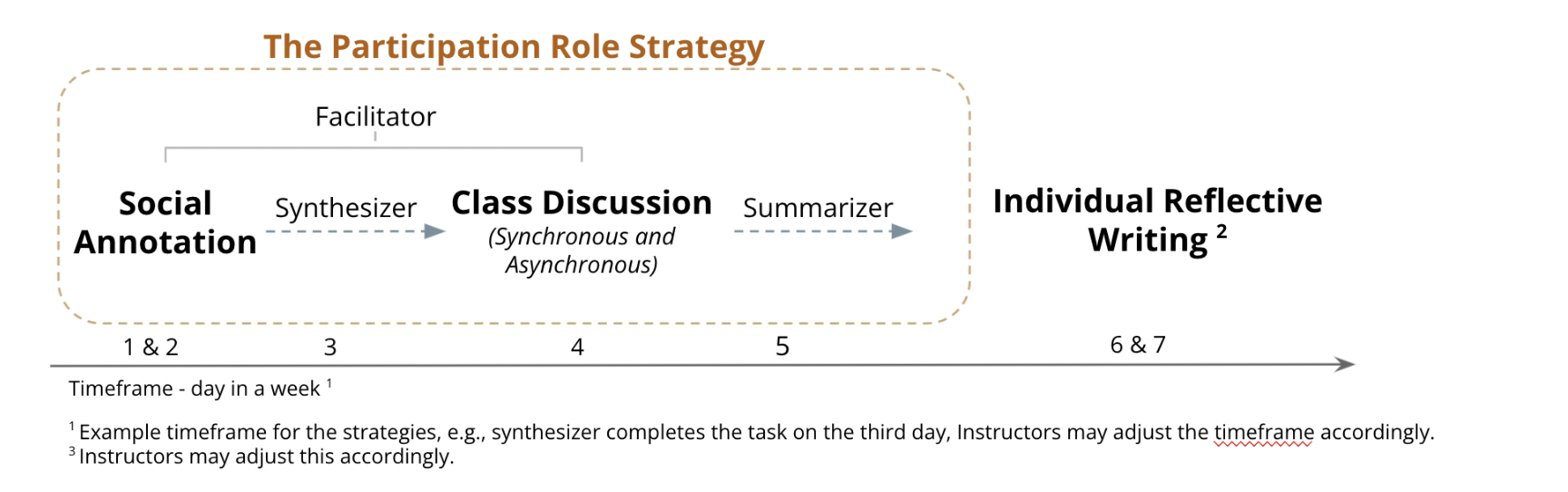
- [Paper] New paper introducing our design and implementation of a generic scaffodling framework: Zhu, X., Shui, H., & Chen, B. (2023). Beyond reading together: Facilitating knowledge construction through participation roles and social annotation in college classrooms. The Internet and Higher Education, 100919.
- [Paper] Check out this literature review to learn more about social annotation practices in education: Zhu, X., Chen, B., Avadhanam, R., Shui, H., & Zhang, R. (2020). Reading and connecting: Using social annotation in online classes. Information and Learning Sciences, 121(5/6), 261-271.